

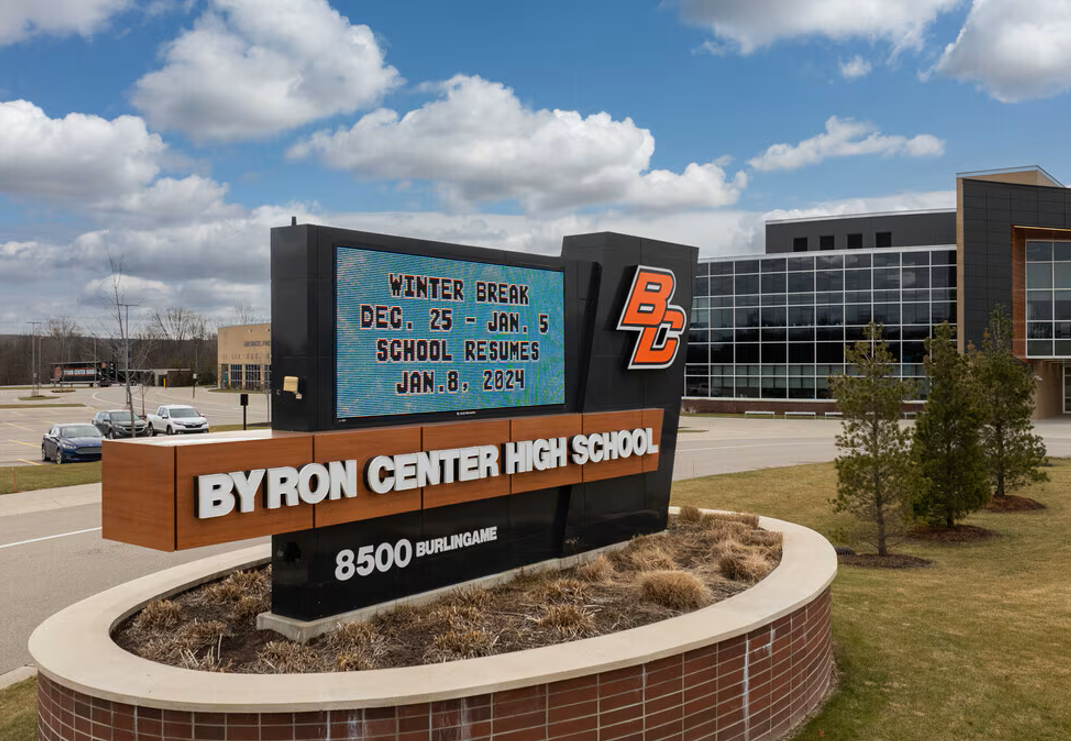
The school day at Byron Center High is just starting and three of us from LaFleur Marketing are sitting in the commons. I think back to days of wolfing down breakfast and hopping on the bus to get to school on time.
I remember the early start demanding a lot from me as a sleep-deprived teen, but the first group of students approaching us are alert and ready. They’ve brought plenty of questions for us to answer in the time we have with them before the next bell.
This isn’t some kind of job shadowing or seminar, though. We’re essentially here as the students’ clients.
Byron Center Brings Real-World Challenges to Its Students
LaFleur is one of a number of local businesses and organizations who participate in Byron Center High School’s yearly design challenge.
Each organization comes with a problem specific to their business that they wish the students to address. Students assigned to each organization conduct initial interviews to understand more about the problem at hand, then begin brainstorming potential solutions. About a week later, groups have a chance to discuss their progress with the organization and receive feedback.
The challenge culminates in the students presenting their final proposals, PowerPoint style, to the organization. We, as the “clients,” then evaluate each team based on how well they understood the problem, the sensibility of their proposals, and how well it appears they worked together.
Perhaps the most unique aspect of the challenge is how we haven’t “made up” a problem for the students to consider. Each organization is encouraged to bring a real need or ongoing project—something that will (hopefully) eventually find a solution whether it comes from the students or not.
For example, the question we brought concerned our plans for an AI knowledge hub and how we could ideally express the benefits of this product to our clients. It’s a real goal in search of real work and answers.
Of course, the students are not marketing experts, just as much as they aren’t zookeepers or landscapers or any other of the variety of fields represented in the challenge. But what an opportunity to develop such an important skill!
RELATED: Bringing design thinking education to local students

Navigating Unknowns and Connecting Context
The fact the challenge’s problems are real means that the solutions the students suggest can’t really be pulled from thin air, either. They must understand enough about the situation and goals for their solutions to make sense, and that isn’t always an easy feat.
Most of the students in our groups had the everyday level of experience using AI you might expect, and certainly not in the ways we aim to apply it to businesses. They had to ask questions starting at fundamental levels:
- Just what is this product of yours?
- How does it work?
- What do you want to do with it?
In turn, we were challenged to answer these questions in ways that made sense and would further the students’ understanding of our goals—and that’s not always easy, either. We found ourselves having to break out of tech jargon habits to redescribe things in different ways.
Questions begat clarifying questions, then branching questions into new topics. We showed a demo of the product and how it could be applied. (Some of the students said it was cool, which made us very happy.)
In our next meetings with the groups, for the feedback session, we were impressed by so many of the inroads students made with the information we provided them. Some of it came from studying other sources and examples. Other progress came from applying their own experiences and skills with social media platforms and other elements. It was exciting seeing where each group made connections to the project that lit their creativity and drove their thinking forward.
Take Your “Group Projects” Outside of the Comfort Zone
We would love to see more projects like the one at Byron Center take shape at every school just for the way it expands the scope students need to take toward gathering information.
Group projects are nothing new, but most of them can be accomplished in a closed bubble of research. This challenge takes that foundational group project element and requires students to seek answers in more direct, real-world situations.
It really isn’t so much different from how we operate at LaFleur. We’re marketing experts, but we often have to engage and direct our skills in ways that apply to the lawyers financial services organizations, and other clients we serve. Some of that knowledge comes from established sources, but the foundational elements and direction often comes through conversations with the clients themselves.
The most effective lesson of the project might just be that you can’t always complete your work in a closed system. You must be open to consulting with experts in other fields, then determine how you can best apply your own skills and talents for the best results.
We’re happy to see that spark being kindled, and we’ll certainly be back next year with a new problem for students to solve.