


You may have missed it—just a new icon, a few extra words in the search bar: “AI Mode.” But this seemingly small update could be one of the biggest changes to Google in years.
With the rollout of AI Mode, Google has fundamentally changed how it delivers answers. Where search used to connect you to websites, AI Mode pulls together a summary, tailored to the user, without necessarily showing where all the information came from. It’s powered by a conversational AI model (Gemini 2.5) that can integrate your data, your preferences, and your location to provide what feels like a personalized assistant.
It’s a new model of trust, relevance, and visibility. And if your business depends on SEO, you need to understand what’s changed,
What is AI Mode?
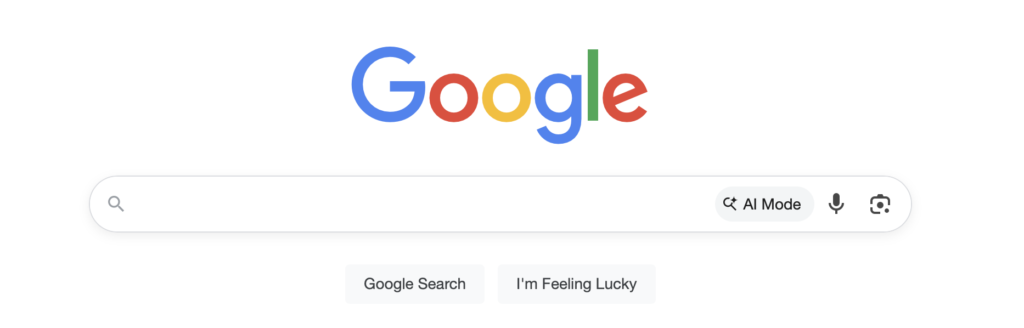
AI Mode is Google’s reimagined search experience, built to give answers, not just links.
When you ask a question, AI Mode delivers a personalized answer based on your past queries, behavioral signals, location, and other factors. Its large language models, in the words of one of my favorite SEO nerds, Mike King, AI Mode, “allows Google to reason about intent over time rather than just intent in the moment.”
AI Mode at work: How a legal consumer might use AI Mode
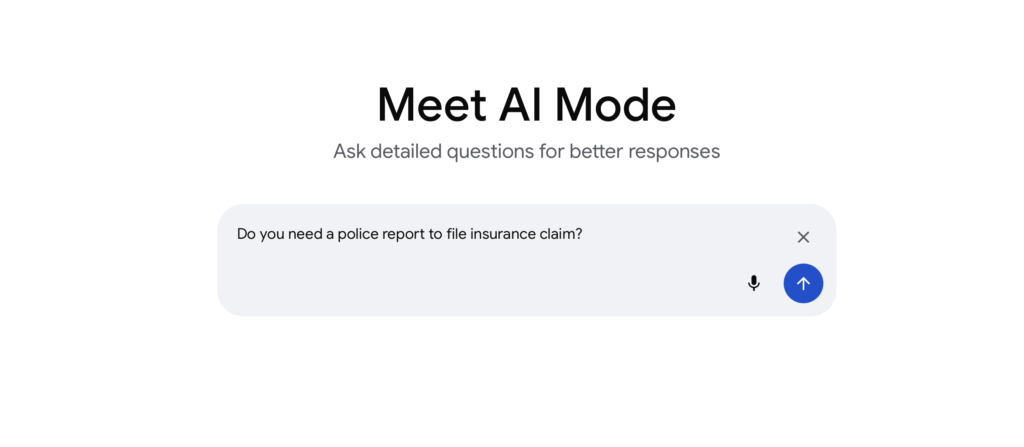
So, what does that mean in the real world? Suppose I was in a parking lot and another vehicle backed into my car. At the time, it didn’t seem like anyone was injured, so no one filed a police report. However, a couple days later, I start to experience neck pain that radiates down my arm.
Like most legal consumers, I decide to start my journey with some DIY research. I hop onto Google and use AI Mode.
This is AI Mode’s response.
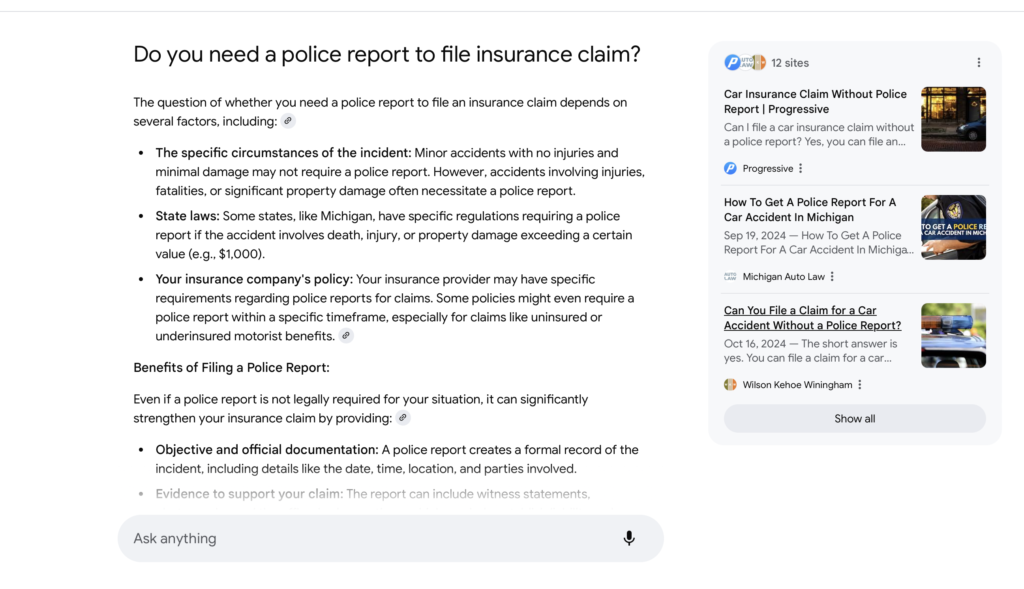
I didn’t tell Google that I was in Michigan, but it identified my location and customized its response, even linking to my friends at Michigan Auto Law.
Now, because AI Mode encourages conversational search, I ask about lawyers.
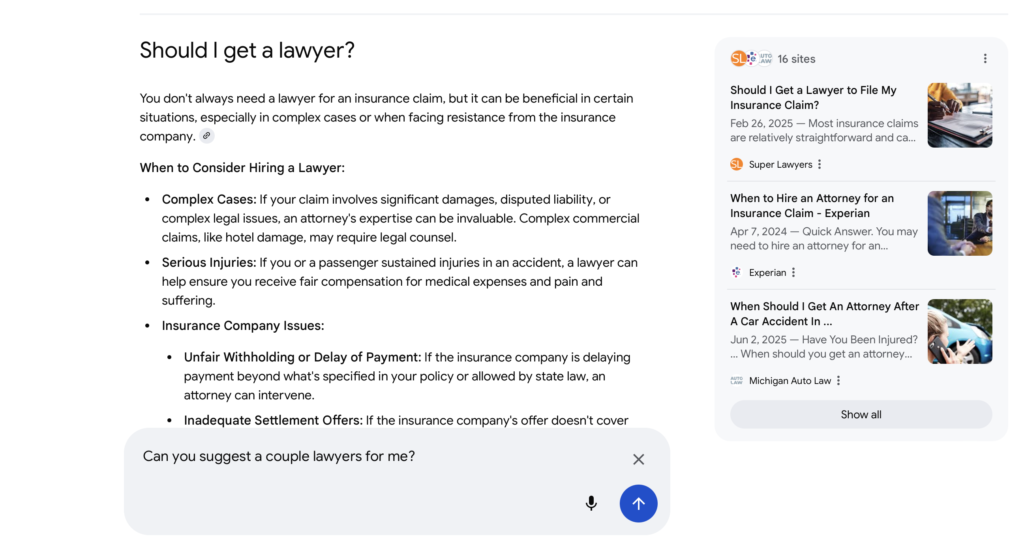

Google assumes that I want a lawyer very close to home, and recommends injury lawyers in my hometown of Holland, Michigan.
But, then, I start to worry about the cost of lawyer. Maybe I just want to do this myself…
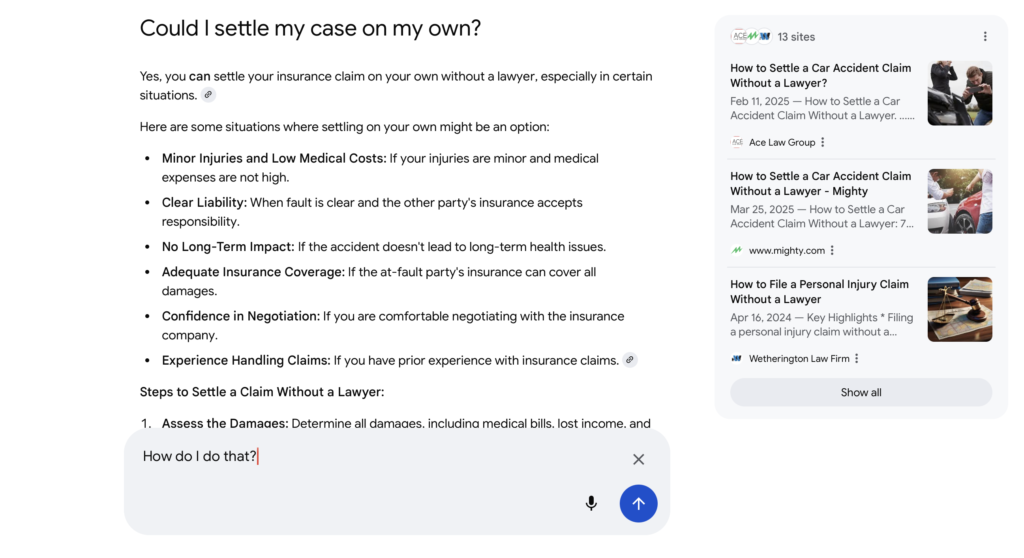
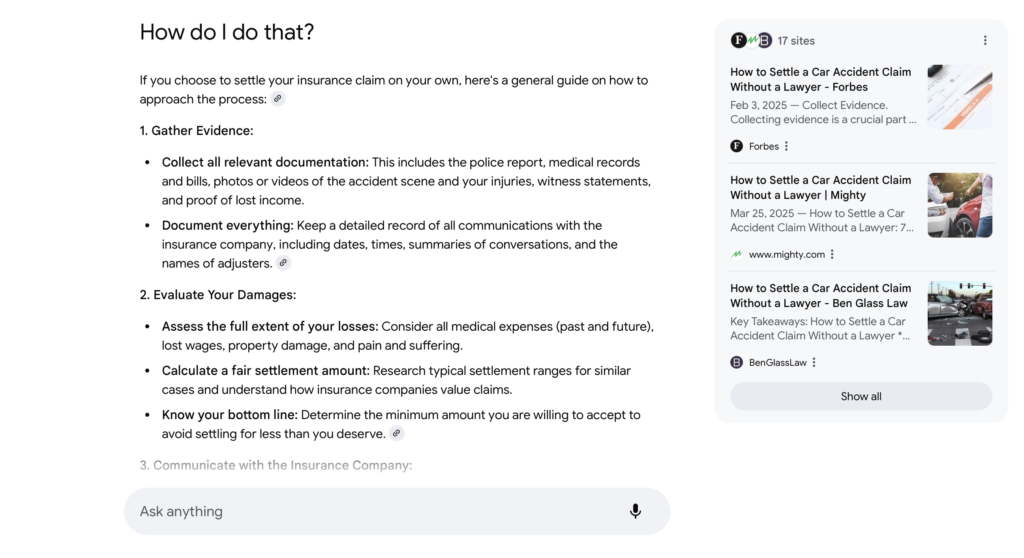
I got a lot of answers without clicking on a single blue link. And that’s exactly what Google wants. This is more than a new layout. It’s a shift from looking things up to getting things done.
And the level of personalization can be remarkable, basing its responses on my interactions with Google. Again, quoting Mike King:
All of this happens inside an invisible architecture powered by your past. Your clicks, your queries, your location, your Gmail threads are all boiled down into a vectorized version of… “you…” A personalization layer that doesn’t just color the margins of the result, but warps the very selection of what qualifies as relevant.
How AI Mode rewrites the rules of search
Google is becoming an answer engine, just like ChatGPT and other generative search tools.
Traditional search engines operated on a simple promise: type a question, get a list of links ranked by relevance. You explore. You choose. You click. Traditional Google serves as an index or an efficient librarian.
AI Mode transforms that model. It interprets your question, gathers relevant context, and delivers a single, synthesized response often with limited citations. This shift removes user choice, compresses discovery, and positions Google as both curator and commentator.
Yes, some sources are cited. But those links may be collapsed or surfaced inconsistently. And users often get what they need without expanding or clicking anything. They may never visit your site, at least when they’re in the information gathering phase of their journey.
This creates both opportunity and risk. If you’re a trusted source, AI Mode can amplify your visibility. But if you rely solely on traditional rankings and mid-funnel educational content to drive traffic and build awareness, you could be left out of the conversation entirely.
How to protect (and promote) your content
Before we talk about strategy, let’s acknowledge something important: the risk isn’t just being overlooked. It’s being misrepresented.
When AI Mode pulls from your content, it doesn’t always preserve your disclaimers, your jurisdictional boundaries, or your carefully framed caveats. Generic legal information can morph into legal advice. Health context can become a blanket recommendation. Financial strategy can be flattened into a soundbite.
And when your brand isn’t cited—or cited poorly—you lose the ability to clarify or correct.
This shift isn’t the end of content marketing. But it is a reset. Here’s how to respond.
Write the best answer, for both people and the algorithm
In AI Mode, it’s not enough to write just for SEO, and it’s not enough to write just for people. You have to do both. You’re writing for a search engine that’s pretending to be a user.
So what does that mean?
It means your content needs to:
- Sound human: Clear, natural, and helpful
- Stay structured: AI needs to understand your content’s purpose and value
- Answer the actual questions that users are asking with context, nuance, and citations
You’re threading the needle between what someone would want to read and what the system needs to understand.
Use structured data and schema markup
AI Mode loves structure. So does Google Search. Use schema markup to help machines understand your content. Some of the most helpful types for law firms:
- FAQPage schema for content that answers common legal questions
- LocalBusiness schema for your firm’s location and contact info
- LegalService schema if you want to go full nerd (and we do)
Structured data doesn’t just help with rankings, it increases the chances that AI Mode trusts your content and quotes it.
Build topical authority, not just one-off posts
AI Mode wants to whether you’re the best person to answer a user’s question. You can help earn that reputation over time by publishing clusters of related content.
Let’s say you’re targeting people who’ve been rear-ended, a common but competitive area in personal injury law. One blog won’t cut it. Instead, you’d create a cluster of content digging into topics like:
- “Who’s at fault in a rear-end collision in Michigan?”
- “Can I still recover compensation if I was partially at fault?”
- “How long do I have to file a claim after a rear-end crash?”
- “Rear-end collisions and whiplash: What insurance companies won’t tell you”
- “How to document vehicle damage and injuries after being rear-ended”
The more depth you offer, the more Google understands: you know your stuff.
Design for human trust: Author bios, reviews, and real voice
AI Mode doesn’t just scrape facts. It looks for:
- Clear authorship (Who wrote this?)
- Credibility (Is this someone I can trust?)
- User signals (Do people stay on this page? Do they leave happy?)
Make sure you’re future-proofing your content and demonstrating your authority with:
- Author bios that highlight your expertise
- Backlinks and even unlinked mentions from authoritative websites
- Google reviews and local trust signals
- Client success stories and testimonials
- A consistent, human voice, not AI sludge
Educate internally and reassess your KPIs
Your board or leadership team might still tie success to traffic. But the rules have changed.
- Show side-by-sides of legacy vs. AI Mode search results
- Explain why click-throughs are down
- Focus on quality of engagement, not just volume
LaFleur: Don’t just chase rankings. Earn relevance
You can’t trick AI Mode. You can’t keyword-stuff your way to the top. But you can:
- Create content people need
- Structure it in a way AI can parse
- Build trust like a human, not a robot
At LaFleur, we help law firms and service-based businesses do exactly that, pairing deep legal expertise with modern content strategy, structured data, and brand voice that doesn’t just show up, but shows leadership.
Schedule a consultation to find out how your current content holds up in AI Mode — and what we can do to help you lead, not lag, in the next era of search.
References
King, Mike. (2025, May 27). How AI Mode Works and How SEO Can Prepare for the Future of Search. iPullRank. Retrieved from https://ipullrank.com/how-ai-mode-works
Reid, E. (2025, May 20). AI in Search: Going beyond information to intelligence. Google. Retrieved from https://blog.google/products/search/google-search-ai-mode-update/